Case study · Techcom Securities
TCBS margin lending platform redesign
A seven-month redesign of the margin lending platform, from domain discovery and loan servicing to purchasing power, risk controls and migration. Approximately 900,000 customers moved across seven teams with no rollback required.
Financial infrastructure
From vendor dependency
to product control.
system
Product. Techcom Securities’ core margin lending platform, covering lending capacity, purchasing power, risk, repayment and loan servicing.
Challenge. Replace a vendor-dependent platform with capabilities internal teams could own and evolve without disrupting existing financial behaviour.
My scope. Product Owner for margin lending, covering the product model, lending and risk logic, service journeys, integrations and migration readiness.
Discovery - redesigning the margin domain
Higher market activity exposed slow product changes, limited operational visibility and heavy dependence on a closed-source vendor system.
I analysed the existing product and mapped the domain into capabilities teams could own independently while preserving the end-to-end lending journey.
Lending pools
Funding capacity, limits, commercial terms and utilisation.
Stock capacity
Security-level financing availability and allocation.
Customer groups
Customer tiers, policies, limits and permissions.
Product configuration
Terms, rates, fees, limits and risk parameters.
Asset management
Cash and securities used for collateral and purchasing power.
Risk & margin calls
Margin ratios, thresholds, warnings and recovery actions.
Loan management
Loan lifecycle and servicing tools from creation to collection.
Reporting
Operational, exposure, business and compliance reporting.
Separate product policy from loan state
A key decision was separating product rules from each customer’s active loan.
Product policy
Rates, terms, limits, fees and extension rules.
Loan state
Principal, interest, payments, extensions, dates and status.
This let business teams manage product configuration while service teams could still explain each active loan clearly.
Loan management - make every loan explainable
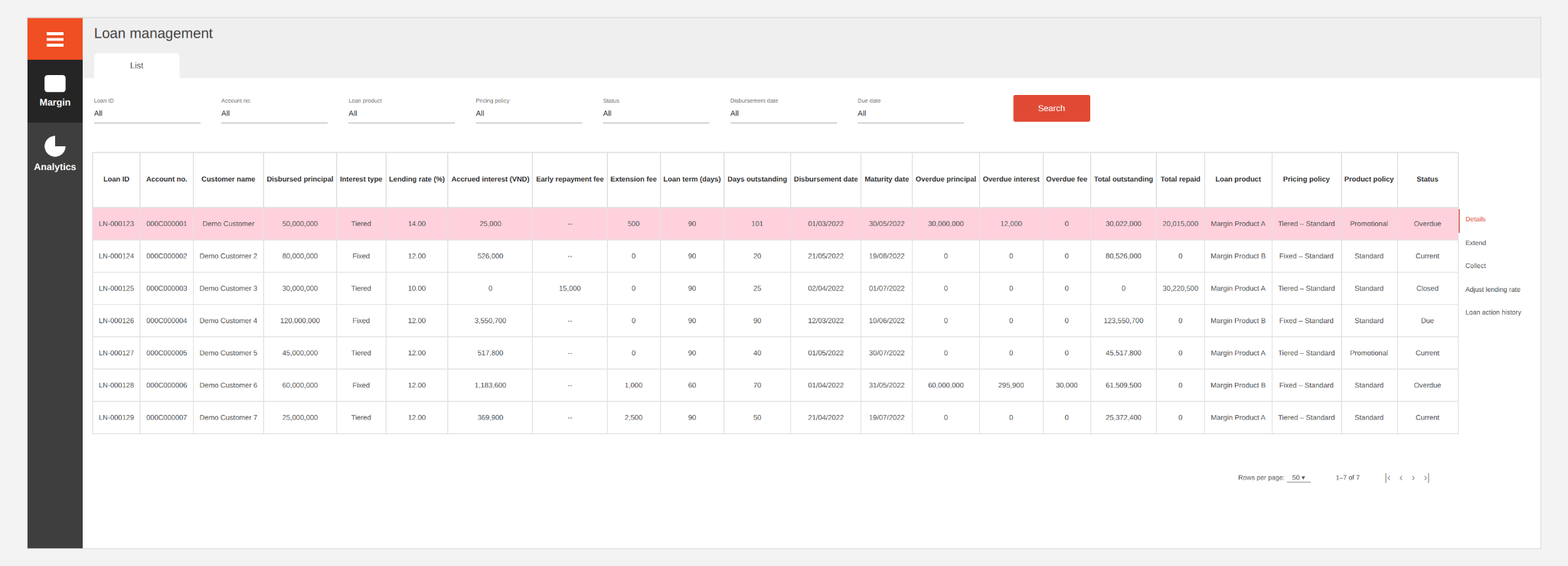
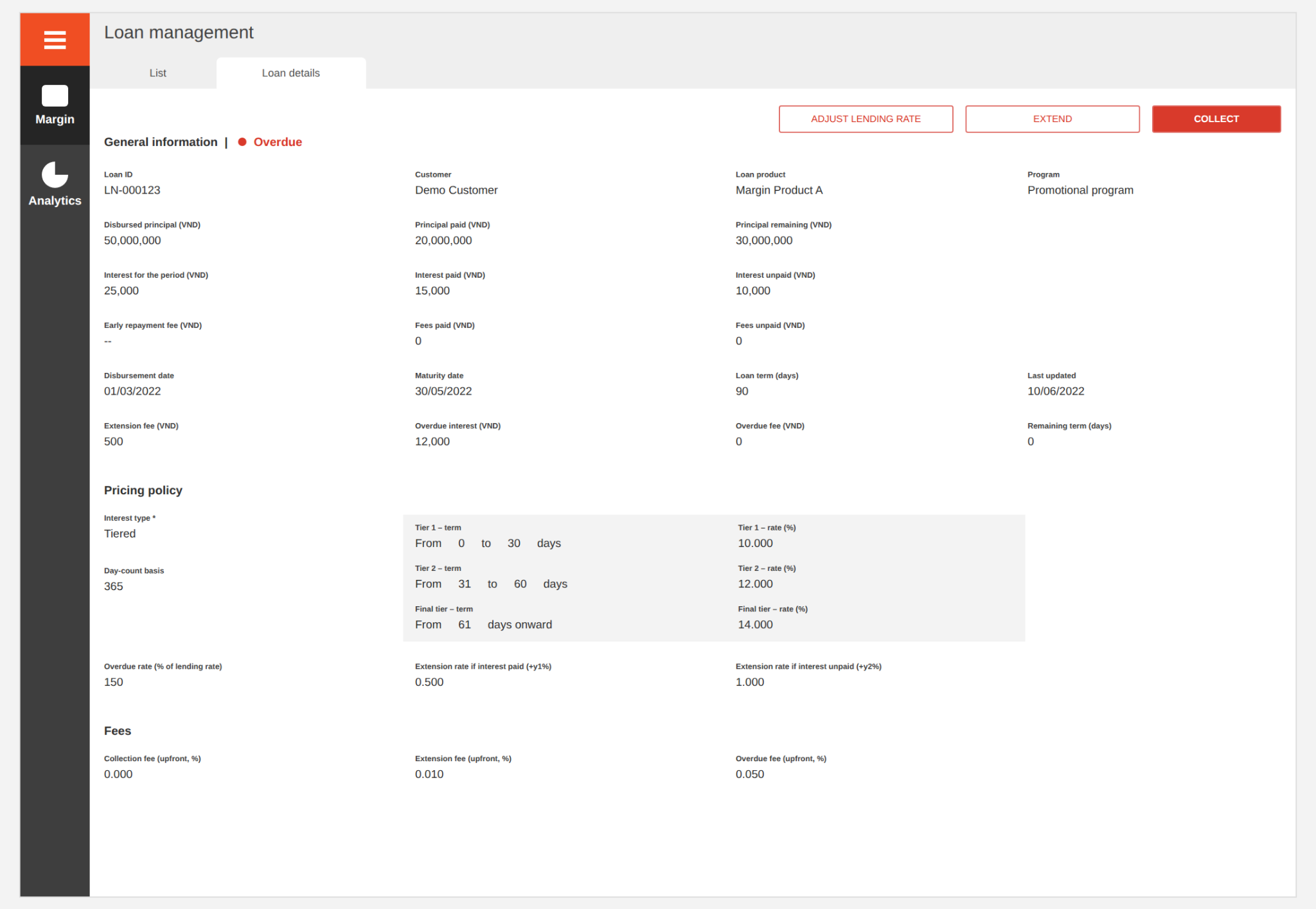
Service teams needed to find the right loan quickly, understand what the customer owed and take the next action without piecing information together across systems.
English mockups with illustrative customer, loan and pricing data.
Status first
Surface overdue, due, current and closed loans quickly.
Paid vs. remaining
Separate what was charged, paid and still outstanding.
Traceable actions
Keep extensions, collections, rate changes and history together.
Two servicing actions needed flexibility without losing control:
Extension pricing
Show product policy with extension count so the resulting price can be explained from the loan's actual state.
Rate adjustment with approval
Allow a customer-specific rate and effective date, with approval and action history.
Internal tools are part of the customer experience: clearer servicing leads to clearer customer answers.
Purchasing power - turn layered controls into one usable number
Purchasing power starts from the customer’s cash and eligible securities, then applies four layers of capacity and policy.
Lending pool
Available capacity and the terms attached to the funding source.
Stock capacity
Financing available for an eligible security.
Customer group
Allocation and lending policy for the segment.
Individual limit
Available capacity after all relevant limits are applied.
The goal was to keep the controls explicit for business teams while exposing one reliable figure to the customer.
Risk - intervene progressively before forced liquidation
The product moved through monitoring, warning and recovery as collateral value changed relative to debt.
Monitor
Recalculate the account's margin position as values change.
Notify
Tell the customer when action is required and what they can do next.
Restore
Apply forced liquidation only when the account remains outside required conditions.
Two decisions shaped forced liquidation:
- Sell only what is needed to restore the required position.
- Prioritise more liquid assets to improve execution reliability.
Repayment - keep cash movement and loan state consistent
Repayment crossed loan management, money movement and the core system.
- 01RequestCustomer submits a repayment
- 02DeductRequest the cash movement
- 03ConfirmConfirm the deduction in the core system
- 04ApplyUpdate the loan after confirmation
- 05NotifyShow the customer the result
The loan was reduced only after the cash deduction was confirmed. This kept loan balance, account balance and repayment status aligned.
Payments were allocated to fees and penalties first, then interest, then principal.
Cross-team integration
Margin lending depended on services owned by other teams, so each integration was defined around the customer journey and its confirmation points.
| Connected capability | What the margin journey needed |
|---|---|
| Account registration | Open a margin account for an eligible customer. |
| Balance information | Read cash and asset balances for purchasing power. |
| Money movement | Deduct cash for repayment and confirm it in the core system. |
My team owned the margin-specific decisions built on those services: purchasing power, loan servicing and risk actions.
Migration and seven-team delivery
Approximately 900,000 customers moved to the new platform in a single cutover, with correct loan information and essential journeys available from the first trading session.
Market-aware cutover
Transition outside trading hours with a weekend verification window.
Rollback readiness
Prepare rollback in advance. It was not required.
Shared product model
Align seven teams around common capability, policy and loan-state definitions.
Journey-led planning
Validate dependencies through complete customer journeys.
Outcomes and lessons
In seven months, the programme redesigned the margin lending domain and migrated approximately 900,000 customers across seven teams in one cutover, without rollback.
Three principles stood out:
- Start with the product model. Clear boundaries make a complex financial platform easier to change.
- Make financial logic explainable. Users should understand both the result and the reason behind it.
- Treat migration as a product outcome. Success means customers keep correct information and working journeys through the transition.